


Table of Contents


Ready to create more pipeline?
Get a demo and discover why thousands of SDR and Sales teams trust LeadIQ to help them build pipeline confidently.

.png)

Total contacts captured is a vanity metric if it isn't paired with account penetration. A list that looks full can still leave most of your target accounts under-covered.
Multi-threaded accounts convert at meaningfully higher rates and are far less likely to go dark when a single champion moves on or stops responding.
Capping contacts per company during capture, rather than maximizing total volume, is the simplest fix for weak account penetration, and it's now built into LeadIQ's Bulk Capture.
Get a demo and discover why thousands of SDR and Sales teams trust LeadIQ to help them build pipeline confidently.
You pulled 4,000 contacts this quarter. Pipeline still looks thin. What happened?
Probably this: your list looks full, but account penetration inside it is thin. A handful of your biggest accounts ate most of your capture budget, and the other 80% of your target accounts got two or three names each, if that. The dashboard says you're prospecting. The pipeline says otherwise.
This is one of the most common blind spots in outbound sales, and it's almost invisible until you go looking for it. Nobody notices a metric that looks healthy in aggregate.
The real problem: coverage, not volume
Most sales orgs still report on total contacts captured, total emails sent, total dials made. Those numbers go up and to the right and everyone feels good. But volume metrics hide a distribution problem: are you actually reaching enough people inside enough accounts, or are you just reaching a lot of people inside a few accounts? That distribution problem has a name: weak account penetration.
The data on buying committees makes the stakes clear. Modern B2B purchases involve six to ten stakeholders or more, and reaching just one contact per account and hoping they'll champion a five-figure (or larger) purchase internally is one of the most common mistakes enterprise sellers make. Contact-level targeting inside accounts, meaning multiple named contacts per account rather than one, drives up to 74% higher meeting conversion and 118% more pipeline according to account-based marketing research.
Account penetration also captures both breadth and depth: how many different contacts and functions you've reached inside an account, and how engaged they actually are. Committee coverage, the average number of engaged stakeholders per active account, is a metric account-based teams increasingly track for exactly this reason.
Three to five contacts per account is a reasonable middle ground for most B2B motions, though mid-market campaigns that generate the most pipeline often reach eleven or more people per account. Either way, the number that matters is how deep you go inside each account, not how many names you collect in total.
Here's the part that doesn't get talked about enough: most prospecting tools and workflows are, by default, built to fill a batch as efficiently as possible. Point a bulk enrichment or capture tool at a list of target accounts and ask it to find and pull, say, 500 people, and it will typically start with the accounts that have the most available contacts to give. Those tend to be your largest logos, the ones with the deepest employee directories and the most public data.
That's efficient. It's also exactly backwards from what a sales team actually wants.
If your list has a mix of enterprise and mid-market accounts, a volume-first capture process will drain the enterprise accounts first and leave your mid-market accounts under-penetrated, sometimes with zero contacts pulled at all. You don't find out until weeks later, when a rep working a mid-market account can't figure out why they only have one name to call.
Buying committees don't wait for you to catch up
Multi-threading exists because single-threaded deals die quietly. A champion goes on leave, changes roles, or simply stops responding, and if that's the only contact you have at the account, the deal doesn't just slow down, it disappears from your pipeline without anyone flagging it as lost.
The stakes are rising, not falling. Sales organizations that pair account-based targeting with account-based advertising see 60% higher win rates than those that don't, and that lift depends on having enough contacts inside the account to actually execute a multi-threaded motion. You can't advertise, sequence, or call your way into a buying committee you never captured.
Marketing feels this gap too. Account-based marketing platforms built around LinkedIn ad engagement and CRM data face the same ceiling: campaign performance and account scoring only mean so much if the underlying contact list inside each account is thin. Marketing can target an account perfectly and still run into the same wall sales does, not enough real contacts to reach once you're there.
And the AI layer on top of prospecting doesn't fix this on its own. If anything, it can make the skew worse. AI-assisted research tools are extremely good at finding every available contact at a given account fast. Point that speed at a volume goal instead of a penetration goal, and you'll hit your number while somehow ending up with worse account penetration than before.
The fix isn't working harder to catch the skew after the fact. It's changing what the capture process optimizes for in the first place. Instead of asking a tool to pull as many contacts as possible until it hits a total, you cap how many contacts it's allowed to pull from any single company.
That one change flips the default. Rather than draining your three biggest accounts and moving on, the process pulls up to your cap from every account on the list, including the smaller ones that would otherwise get skipped once the batch total was reached.
This is exactly the gap LeadIQ's Bulk Capture closes with its new per-company cap. You set a maximum number of contacts per company in the Bulk Capture modal, and the run treats that as a ceiling, not a target. Companies with fewer available contacts still return everything they have. Companies with hundreds of potential matches get capped at the number you set, freeing up capture budget for the rest of your list. It's live for every LeadIQ customer now, with no flag or setup step required.
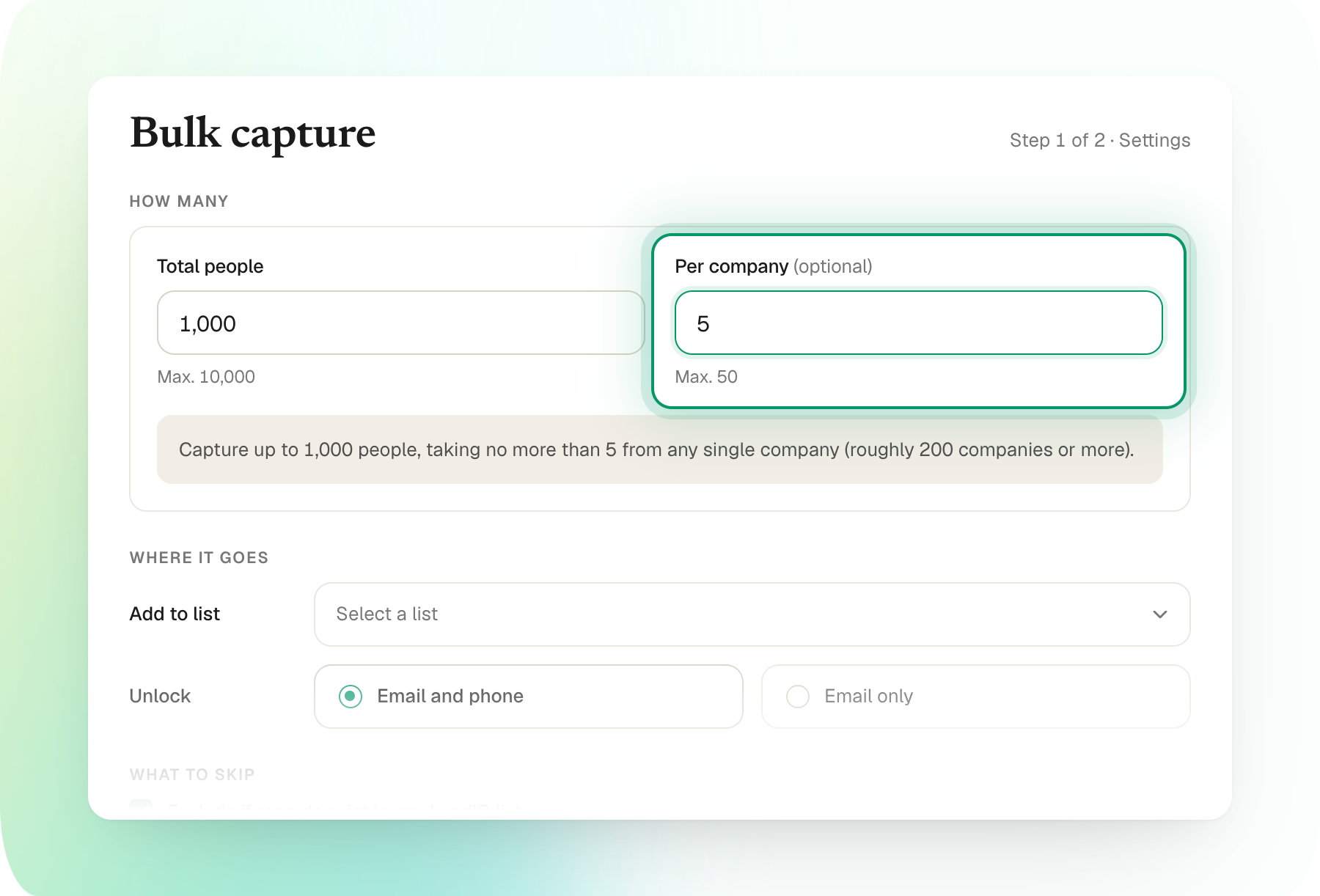
For teams running Chrome extension-based prospecting alongside bulk workflows, the same principle applies whether you're capturing one contact at a time or five hundred: the goal is even account penetration across your total addressable list, not maximum volume from whichever accounts happen to be easiest to fill.
It's a small setting with an outsized effect on pipeline health, because pipeline health was never really about how many contacts you captured. It was always about how deep you actually got inside each target account. Capping contacts per company during capture, rather than maximizing total volume, is the simplest fix for weak account penetration, and it's now built into LeadIQ's Bulk Capture.
Ready to check your own account penetration? Book a demo and see how Bulk Capture's per-company cap fits into your prospecting workflow.
.png)
.png)
.png)